Academic and scientific exchanges between China and Africa under the Belt and Road Initiative serve as a vital platform for mutual learning between civilizations and an important bridge for South–South cooperation. To foster dialogue and collaboration between research institutions in China and Tanzania and explore opportunities for joint research and the cultivation of young talent, a delegation of scholars from the Nelson Mandela African Institution of Science and Technology (NM-AIST), Tanzania, visited the School of Chemical Biology and Biotechnology (SCBB) at Peking University Shenzhen Graduate School (PKU Shenzhen) on September 28, 2026. The delegation comprised Professor Hulda Shaidi Swai, Dr. Elingarami Sauli Nkya, and Mr. Erick Amos Msafiri (Li Yiqian), a master's student. Through discussions, academic seminars, and visits to research facilities, the two sides engaged in in-depth exchanges on their respective research areas and explored opportunities for future collaboration.
The visit officially commenced with a meeting in the morning. Professor Li Zigang, Executive Dean of SCBB, extended a warm welcome to the Tanzanian delegation. Both sides introduced their respective institutions, outlining their development, key research areas, and priorities, before exploring potential areas for collaboration.
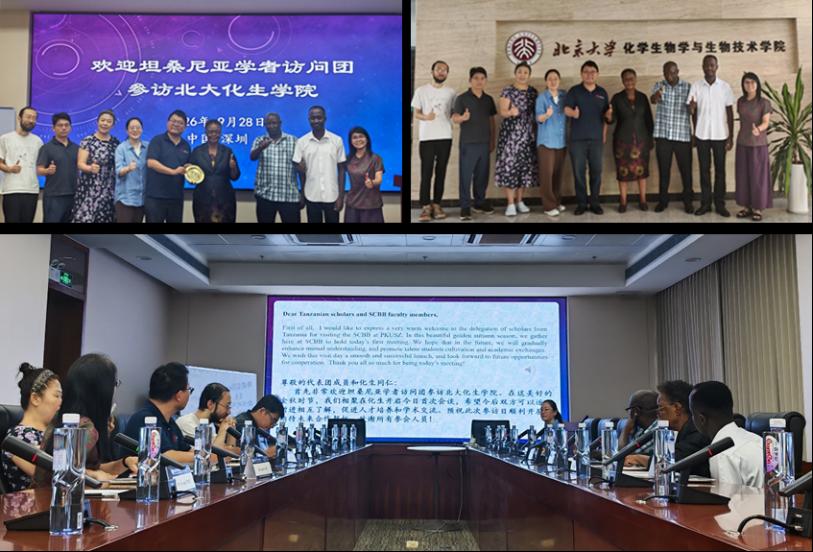
The two sides meet for academic exchanges.
During the academic exchange session, the visiting scholars held discussions with Professor Li Zigang and Professor Jiang Yanlong, who introduced representative research achievements and cutting-edge research directions from their respective groups in the field of chemical biology. Participants engaged in in-depth discussions on relevant research topics and exchanged academic perspectives.
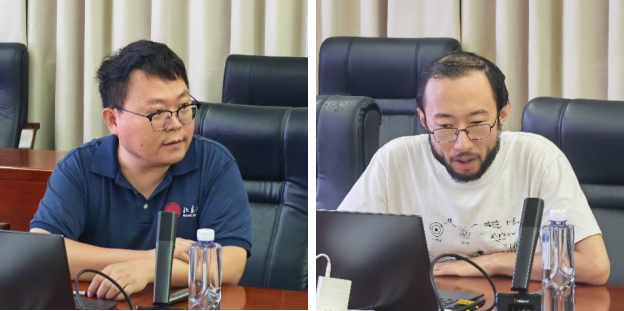
Professor Li Zigang and Professor Jiang Yanlong introduce their research.
In the afternoon, the delegation visited SCBB's Laboratory Animal Center, Instrumentation Center, and the laboratories of the research groups led by Professor Cao Yu and Professor Jiang Yanlong.
At the Laboratory Animal Center, faculty members Zhuo Zhenjian, Liao Wenfeng, Zeng Rufeng, and others introduced the center's operations, management systems, and development achievements. They also guided the visitors on a tour of the animal housing facilities. Both sides exchanged views on practical approaches to the standardized management of laboratory animals.
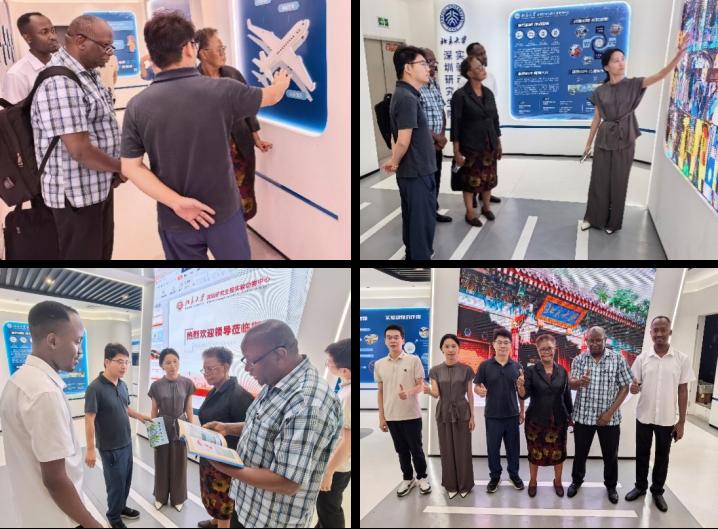
The delegation visits the Laboratory Animal Center.
At the Instrumentation Center, faculty members Zhou Liyan, Huang Yangmei, Zhang Lele, Li Lin, and Xie Hao presented a range of major instruments and equipment used in the school's biological and chemical research, demonstrating the operation and applications of selected instruments. They also addressed the delegation's questions regarding equipment maintenance and operation, as well as the shared use of research facilities, offering the visitors a closer look at SCBB's advanced research infrastructure.
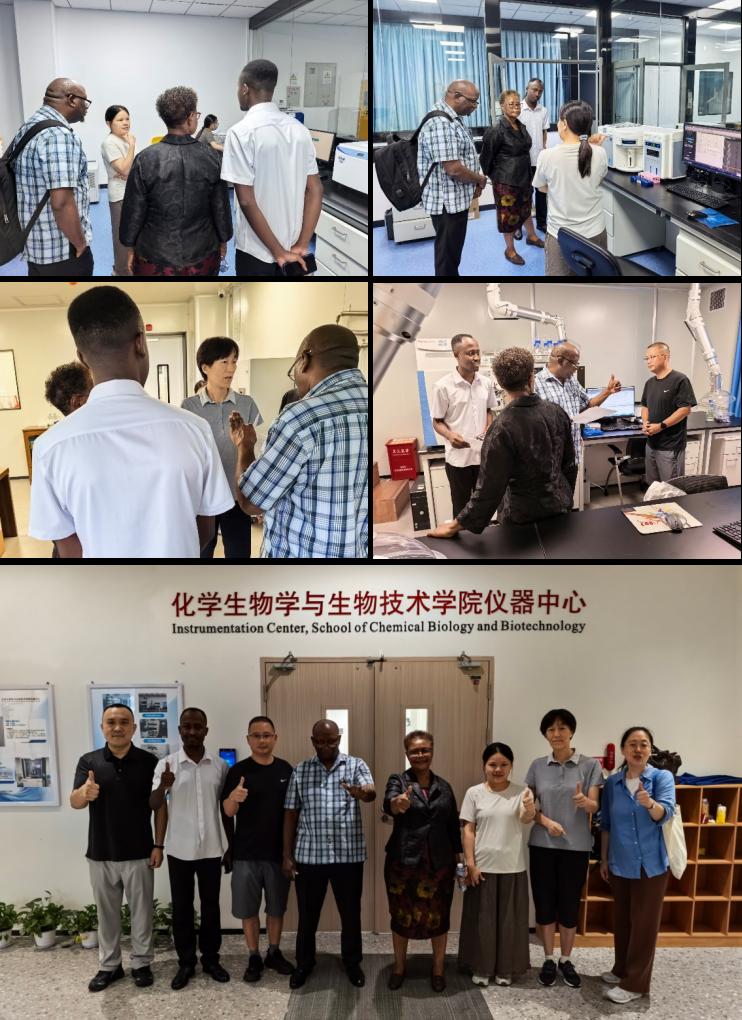
The delegation visits the Instrumentation Center.
The delegation then visited the laboratories of Professor Cao Yu's and Professor Jiang Yanlong's research groups. Student representatives introduced the laboratories' main research areas and equipment, providing an overview of their ongoing research activities. Drawing on their own research experience, the Tanzanian scholars engaged in discussions with the students and spoke highly of their presentations and research capabilities.
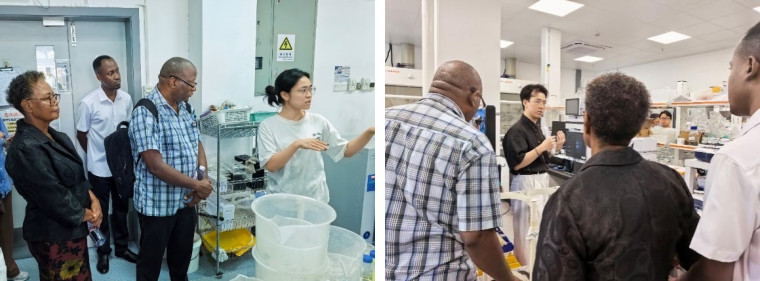
The delegation visits the laboratories of Professor Cao Yu's and Professor Jiang Yanlong's research groups.
This visit marked the first time SCBB has hosted a delegation of scholars from an African country since its establishment. It represents an important step in the school's efforts to expand international academic and scientific exchanges and contribute to cooperation under the Belt and Road Initiative. The visit brought the two sides closer academically and laid a solid foundation for future collaboration in scientific research and talent development.
Building on Shenzhen's strengths as a hub of innovation, SCBB will continue to embrace openness, inclusiveness, mutual benefit, and win-win cooperation in its international engagement, further expanding its global academic network. Looking ahead, the school will deepen its partnerships with NM-AIST and other research institutions in countries along the Belt and Road, exploring practical avenues for academic exchanges, joint research, and talent cultivation. Through these efforts, SCBB will continue to contribute the knowledge and expertise of PKU to closer China–Africa academic, scientific, and cultural exchanges and the sustained development of South–South scientific and technological cooperation.