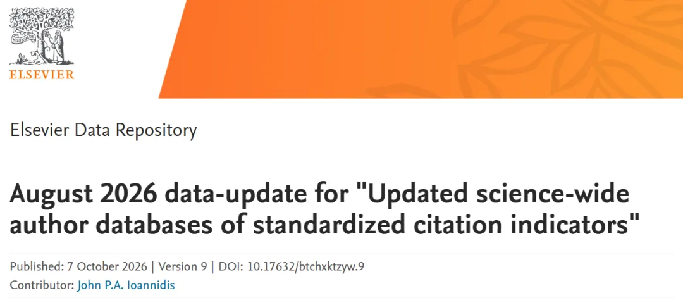
On October 7 local time, the team of Prof. John P. A. Ioannidis at Stanford University, in collaboration with Elsevier, released the latest Stanford World's Top 2% Scientists list.
The lists are based on data from the Scopus database and provide standardized information on various bibliometric indicators, including total citations, the h-index, the co-authorship-adjusted hm-index, citations by authorship position, and a composite indicator (c-score). The data are also cross-referenced with the Retraction Watch database to identify each scholar’s retracted publications and the citations accrued to those retracted papers.
To account for differences across research disciplines, the rankings classify scientists into 20 broad subject fields and 174 subfields. Each field and subfield has its own percentile benchmarks, helping to prevent scholars in smaller disciplines from being overshadowed by those in larger fields.
The rankings are divided into two categories: the career-long impact ranking and the single-year impact ranking. The former can serve as a reference for assessing scholars’ long-term academic contributions, while the latter provides insights into research vitality and the cultivation of academic talent.
The rankings are intended to promote transparency in research. A scholar’s absence from the lists simply means that their composite indicator score does not meet the threshold for inclusion; it does not imply that the scholar has failed to produce excellent research.
According to the latest statistics, Peking University Shenzhen Graduate School (PKUSZ) has achieved a record-high number of scholars selected for both rankings in this edition.
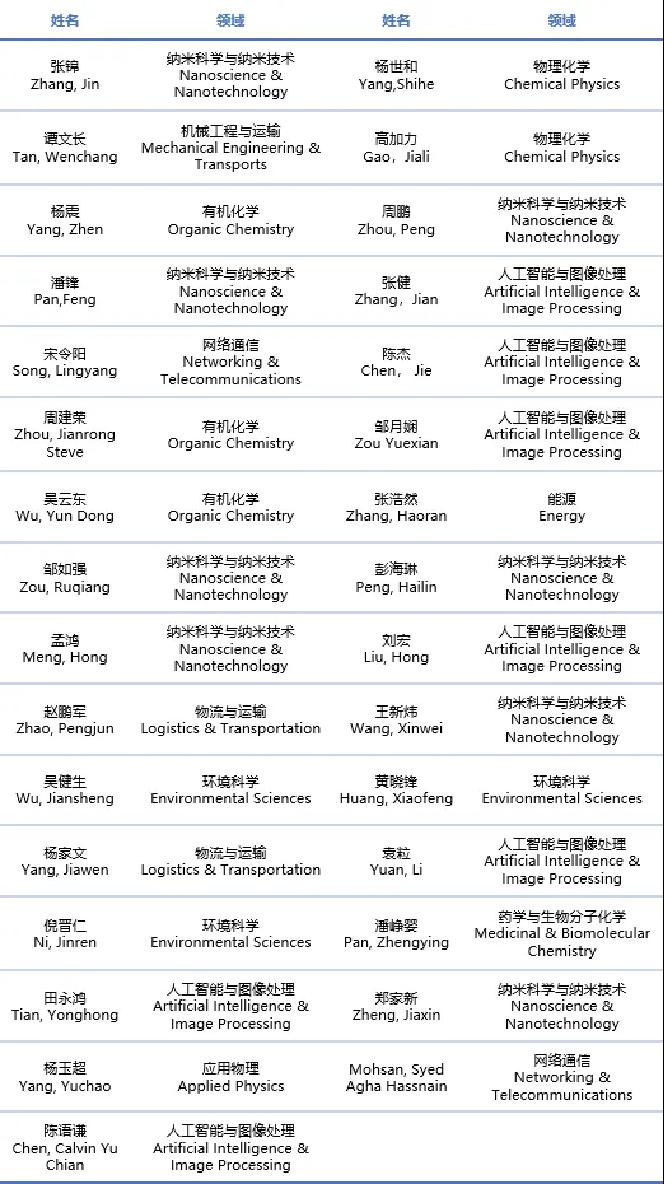
The following 31 PKUSZ scholars have been included in the latest edition of the World’s Top 2% Scientists career-long impact ranking, listed in no particular order: Jin Zhang, Wenchang Tan, Zhen Yang, Feng Pan, Lingyang Song, Jianrong Zhou, Yundong Wu, Ruqiang Zou, Hong Meng, Pengjun Zhao, Jiansheng Wu, Jiawen Yang, Jinren Ni, Yonghong Tian, Yuchao Yang, Yuqian Chen, Shihe Yang, Jiali Gao, Peng Zhou, Jian Zhang, Jie Chen, Yuexian Zou, Haoran Zhang, Hailin Peng, Hong Liu, Xinwei Wang, Xiaofeng Huang, Li Yuan, Zhengying Pan, Jiaxin Zheng, and Mohsan Syed Agha Hassnain.
A total of 31 PKUSZ scholars have been included in the career-long impact ranking.
The following 50 PKUSZ scholars have been included in the latest edition of the World’s Top 2% Scientists single-year impact ranking, listed in no particular order:
Jin Zhang, Jiawen Yang, Zhen Yang, Feng Pan, Yonghong Tian, Yuchao Yang, Yuqian Chen, Yuexian Zou, Lingyang Song, Li Yuan, Jian Zhang, Jie Chen, Ge Li, Hong Liu, Shengdong Zhang, Shihe Yang, Jianrong Zhou, Yundong Wu, Ruqiang Zou, Hong Meng, Jiaxin Zheng, Pengjun Zhao, Zaichun Zhu, Jiansheng Wu, Jinren Ni, Nan Xu, Haodong Ji, Haoran Zhang, Guoyu Qiu, Fanyang Mo, Hang Zhou, Kai Lei, Yinguo Xiao, Peng Zhou, Hailin Peng, Jiali Gao, Hui Zeng, Wei Gao, Ke Yu, Mengyuan Liu, Daquan Zhou, Mingchao Wang, Xinwei Wang, Xiaofeng Huang, Junqing Tang, Luyi Yang, Weihao Yu, Qian Li, Husain Mudasser, and Mohsan Syed Agha Hassnain.
A total of 50 PKUSZ scholars have been included in the single-year impact ranking.
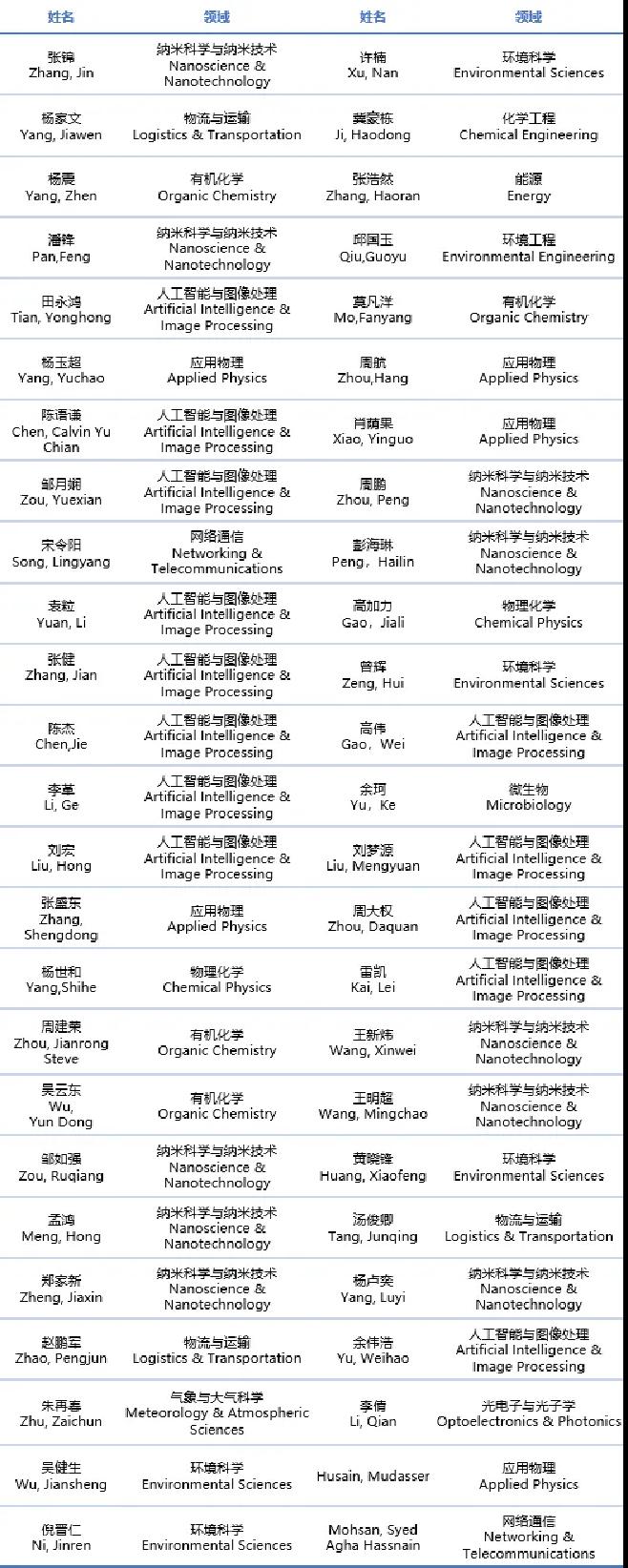
Compared with the eighth edition of the rankings released in 2025, PKUSZ has added six scholars to the career-long impact ranking and nine to the single-year impact ranking. These gains reflect continued progress in strengthening PKUSZ’s academic talent pool.
The selected scholars represent a diverse range of research fields, including applied physics, artificial intelligence and image processing, environmental science and engineering, logistics and transportation, mechanical engineering and transportation, meteorology and atmospheric sciences, nanoscience and nanotechnology, networking and telecommunications, organic chemistry, physical chemistry, and energy. These fields closely align with Shenzhen’s strategic emerging industries and industries of the future under its “20+8” industrial development framework.
The results underscore PKUSZ’s significant progress in developing a high-caliber academic workforce and provide further impetus for fostering synergies between academic research and regional industrial development.
Data source: https://elsevier.digitalcommonsdata.com/datasets/btchxktzyw/9