The first time Korean girl Aerin experienced drone delivery in Shenzhen, she stood at the delivery station, tilting her head up to watch the buzzing little device slowly descend. A few passersby were also watching. A child tugged at his mother's hand and shouted, "Mom, look! A plane is delivering food!" Aerin couldn't help but laugh. Back in Seoul, she had also ordered takeout — a delivery driver on a scooter would ring the doorbell, hand over steaming hot samgyetang (ginseng chicken soup) with both hands, and add an extra "please enjoy your meal." But in Shenzhen, food fell from the sky, and the real-time flight path on her phone screen, like a moving dotted line, drew the word "future" right before her eyes.
Later, she wrote this experience into her observation notes. Not to record "Shenzhen is so advanced," but to reflect: "If this drone delivery scene were made into a short video, and the thumbnail read 'Sci-Fi Comes True' versus 'Too Lazy to Go Out Today,' which title would get more clicks?" This way of thinking has accompanied her throughout her two full years in Shenzhen.
Aerin is from Seoul, a Korean student at Peking University HSBC Business School. She studies how media framing shapes people's expectations and reactions — in her own words, "even a tiny thumbnail title can influence what people think they are about to see." But after nearly two years of living in Shenzhen, she has realized that her role extends far beyond academia. She has become a kind of "Interpreter": interpreting China for Korea, interpreting the classroom into life, and interpreting the grand vocabulary of APEC into language that ordinary people can truly connect with.
Aerin at PHBS
First Arrival in Shenzhen: When "Scanning QR Codes" Becomes Instinct
In the fall of 2024, Aerin dragged two suitcases out of Bao'an Airport. The humid, warm southern air, thick with the scent of plants, rushed toward her — completely different from Seoul's dry autumn. She took a deep breath, feeling a bit nervous but mostly excited: "I'm finally going to live here."
She was born and raised in Seoul and majored in media communicationas an undergraduate. Korea's education system gave her a solid academic foundation. But her decision to pursue further studies in China went beyond the word "academic." "I wanted to understand China better — not just academically, but through daily life, language, and business culture," she says. "China plays such an important role in Asia and the global economy. I felt that studying here would broaden not only my academic perspective but also the way I understand people, society, and the region we share."
But she didn't expect the first "cultural shock" to come so quickly.
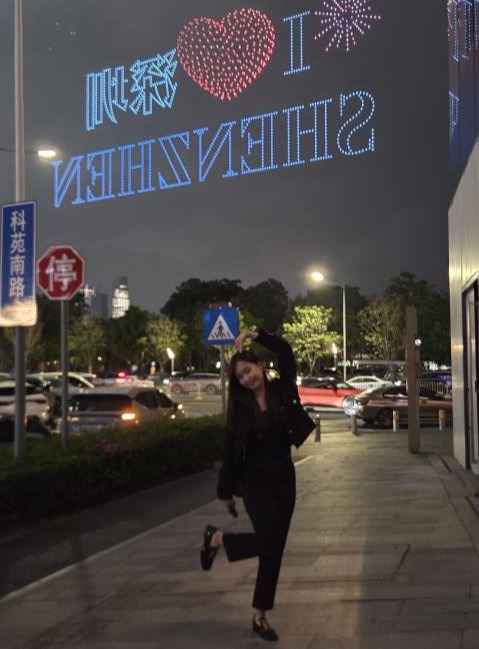
Aerin on Shenzhen street
On her third day in Shenzhen, she went to a small shop near the school to buy water. The elderly man ahead of her pulled out his phone, scanned a code with a "pa," and walked away with his water. The entire process took less than five seconds. When it was her turn, she fumbled in her bag for a banknote. The cashier took it, smiled, and said, "Miss, using WeChat or Alipay would be more convenient." She hadn't fully set up her payment apps yet, so she could only smile apologetically and made a mental note.
That night, back in her dormitory, she spent a full hour figuring out how to link her bank card and activate the payment functions. "In Korea, we also use mobile payments, but not as widespread or as fast," she says. "Shenzhen is different — faster, denser, more 'omnipresent.' Grocery shopping, taking the subway, riding a shared bike, buying a roasted sweet potato from a street stall — everything can be done by scanning a code."
A month later, she had become one of those people who "pa" and walk away. Once, when she returned to Korea to visit family, she habitually pulled out her phone to scan a code at a convenience store in Seoul, only to find the clerk staring at her blankly. She then realized what she was doing and laughed as she took out her credit card. "That's when I knew I had been fully 'assimilated' by Shenzhen," she says.
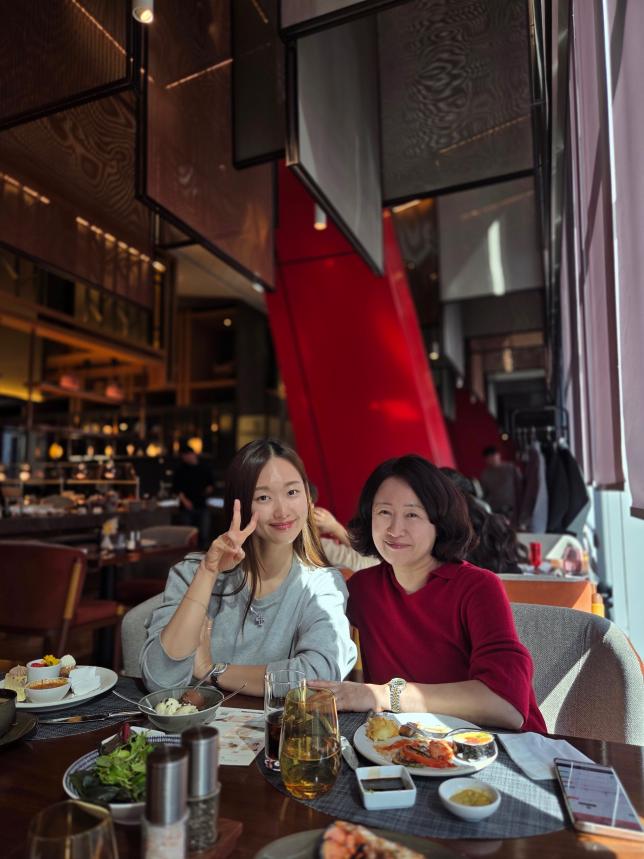
Aerin and her mom
Suan Cai Yu and Winter Melon Soup: The Stomach Adapts Faster Than the Heart
If the change in payment methods was a rational adaptation, the shift in her eating habits was a "chemical reaction" that Aerin herself hadn't anticipated.
In Seoul, she occasionally ate Chinese food, but it was mostly Korean-style jajangmyeon (black bean noodles) and tangsuyuk (sweet and sour pork). After arriving in Shenzhen, her Chinese classmates took her to a Hunan restaurant and ordered a table full of dishes. The first time she tasted suan cai yu (pickled cabbage fish), she was stunned — the explosion of sour, spicy, fresh, and fragrant flavors in her mouth was something she had never experienced before. From that day on, suan cai yu became her "destiny dish." She also fell in love with winter melon soup — light, warm, and comforting, leaving her feeling soothed after drinking it. "Chinese food can be both healing and nuanced," she says, her eyes narrowing slightly as if savoring the memory of that sweetness.
Of course, she occasionally misses Korean food. Shenzhen has quite a few Korean restaurants, and she has visited several. The flavors are fairly authentic, but something always feels missing. "Maybe it's missing that 'made by Mom' feeling," she says with a smile. But most of the time, she enjoys exploring Chinese cuisine. "Discovering local dishes has been one of the most enjoyable ways for me to connect with everyday life here."
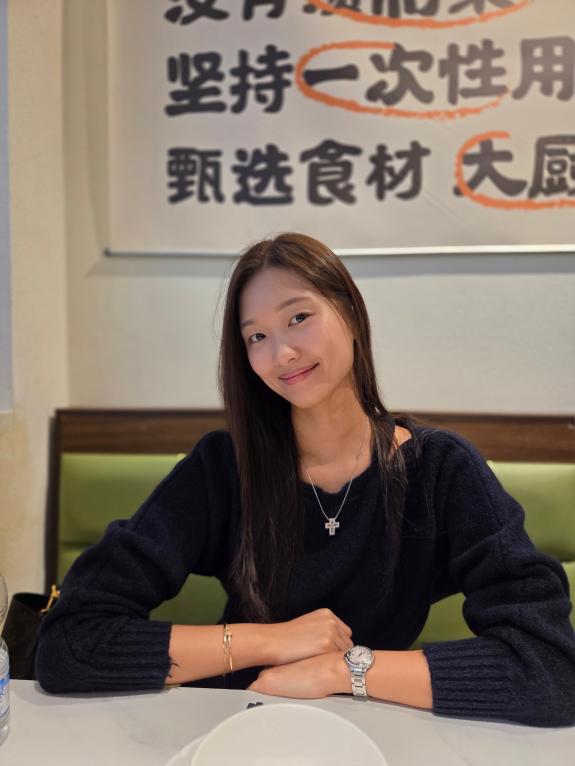
Aerin and her mom
Suan Cai Yu and Winter Melon Soup: The Stomach Adapts Faster Than the Heart
If the change in payment methods was a rational adaptation, the shift in her eating habits was a "chemical reaction" that Aerin herself hadn't anticipated.
In Seoul, she occasionally ate Chinese food, but it was mostly Korean-style jajangmyeon (black bean noodles) and tangsuyuk (sweet and sour pork). After arriving in Shenzhen, her Chinese classmates took her to a Hunan restaurant and ordered a table full of dishes. The first time she tasted suan cai yu (pickled cabbage fish), she was stunned — the explosion of sour, spicy, fresh, and fragrant flavors in her mouth was something she had never experienced before. From that day on, suan cai yu became her "destiny dish." She also fell in love with winter melon soup — light, warm, and comforting, leaving her feeling soothed after drinking it. "Chinese food can be both healing and nuanced," she says, her eyes narrowing slightly as if savoring the memory of that sweetness.
Of course, she occasionally misses Korean food. Shenzhen has quite a few Korean restaurants, and she has visited several. The flavors are fairly authentic, but something always feels missing. "Maybe it's missing that 'made by Mom' feeling," she says with a smile. But most of the time, she enjoys exploring Chinese cuisine. "Discovering local dishes has been one of the most enjoyable ways for me to connect with everyday life here."
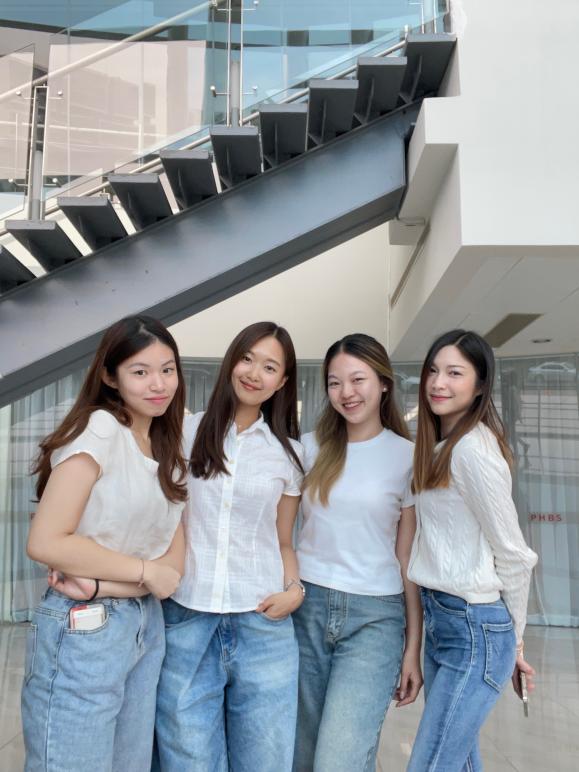
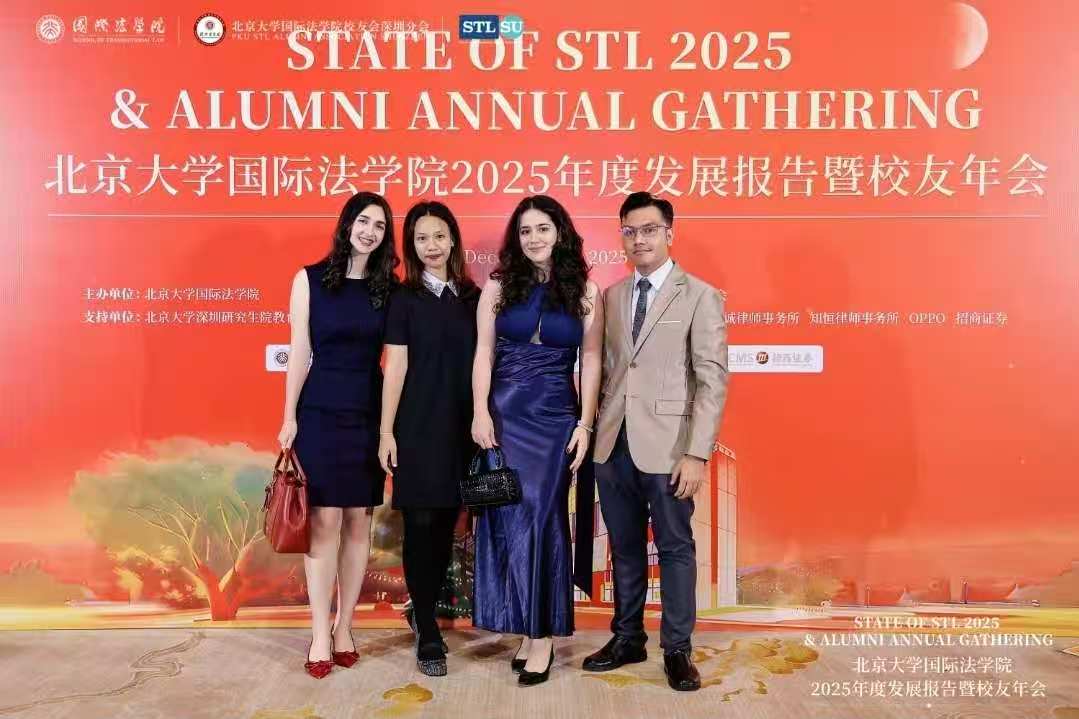
Aerin and her friends
"It was precisely this naturalness that made me feel that Shenzhen is not just inclusive, but deeply human," she says. "Sometimes, kindness is most powerful when it is quiet and genuine."
The hotpot meal lasted nearly three hours. When they finally left, the night breeze in Shenzhen had turned cool. She walked back to the dormitory with her classmates, the streetlights stretching their shadows long on the ground. She suddenly felt that this unfamiliar city seemed to slowly warm up as people drew closer to one another.
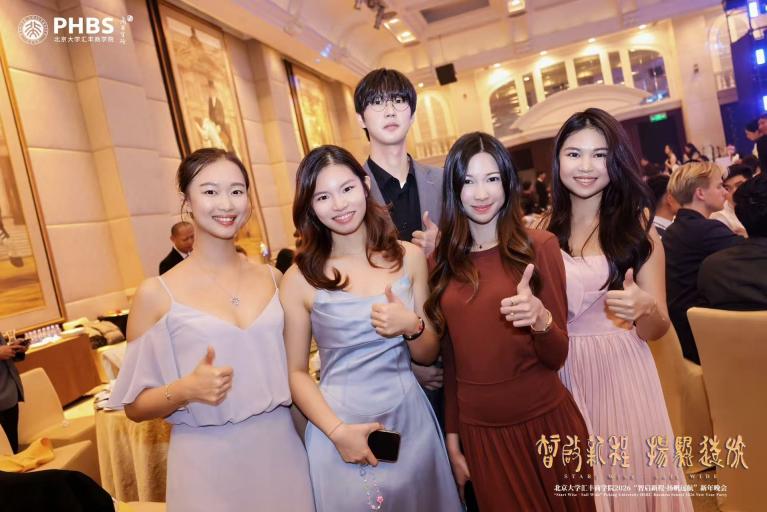
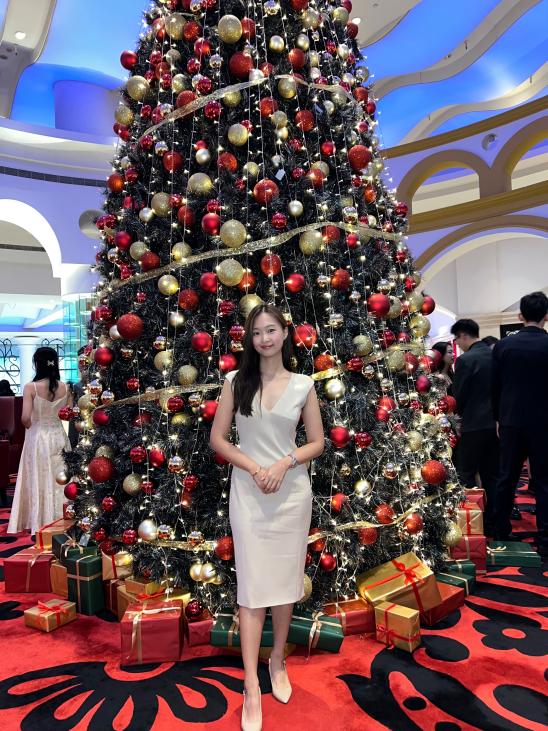
Aerin at 2026 PHBS New Year Party
A Professor and a Way of Thinking
At PHBS, one professor left an especially deep impression on Aerin — Professor Jooyoung Park.
Aerin's thesis was completed under Professor Park's guidance. She remembers the first time they discussed her thesis topic. She had prepared several ideas, each of which she thought was quite well-considered. But after listening, Professor Park didn't say "good" or "not good." Instead, she asked a question: "Why is your research question important?"
Aerin hesitated, then began to explain. But Professor Park continued to press: "When you say 'important,' important to whom? Academia? Industry? Or ordinary people? These three kinds of 'importance' may be completely different."
That discussion lasted nearly an hour. When Aerin walked out of the office, she was holding a draft densely covered with the professor's annotations, but her mind was clearer than ever before. "She never let me settle for vague ideas or incomplete reasoning," Aerin recalls. "Through this process, I learned what serious academic work truly demands."
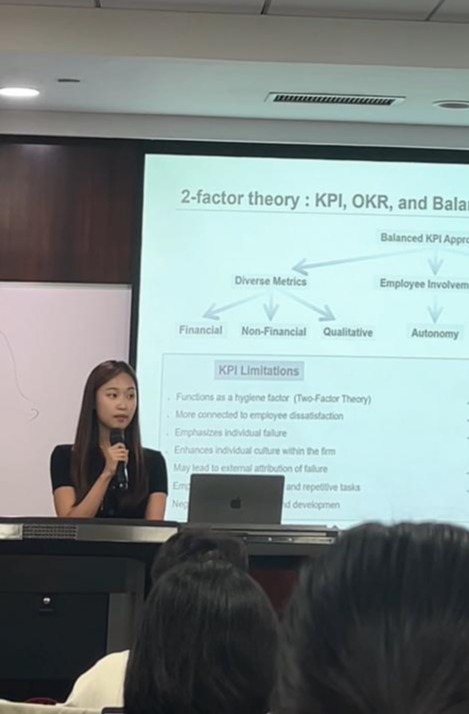
Aerin in class
But Professor Park gave her far more than research skills. "She taught me a way of thinking — more carefully, more responsibly, and with greater depth," Aerin says. "I now understand that scholarship is not just about producing results, but also about cultivating discipline, clarity, and sincerity in the way we approach ideas."
This influence continues to this day. In every class discussion, in every team collaboration, she asks herself: Is my argument sufficiently supported? Am I expressing a viewpoint, or am I demonstrating the process of thinking?
Once, during a group project, a team member proposed a solution, and the others quickly agreed. Aerin didn't immediately second it. Instead, she said, "Can we first think about what the assumptions of this plan are? If those assumptions don't hold, would our conclusion still be valid?" The room fell silent for a few seconds, and then everyone began to re-examine the plan. In the end, they found a more solid framework.
"This is probably what Professor Park taught me — don't be afraid to ask 'why,' and don't be afraid of making others uncomfortable," Aerin says. "Good thinking often starts with questions that aren't so easy to answer." Reflecting on this, Aerin recalled a popular internet meme these days about "people going silent when faced with a difficult question." She smiled and said, "I try my best to be the first to break the silence."
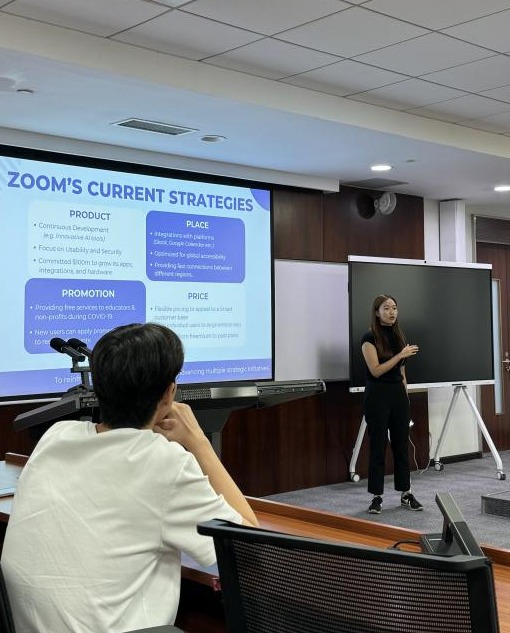
Aerin doing class presentation
"Interpretation" Moments in the Classroom
In cross-cultural group collaborations, Aerin has gradually found her own unique place.
Once, a small conflict arose in her group. An international student directly pointed out a problem in a Chinese classmate's proposal in the group chat, using quite direct wording. The Chinese classmate didn't reply, but Aerin noticed that she became noticeably quieter in subsequent discussions.
Aerin privately talked to each of them separately. She first said to the international student: "Your feedback is valuable, but in China, directly pointing out someone's problem may make them feel offended. You could try saying something like, 'I think this direction is great, but if we could adjust this part, it might be even better.'" Then she said to the Chinese classmate: "He didn't mean any harm. He's just used to this communication style. His suggestion itself is quite constructive."
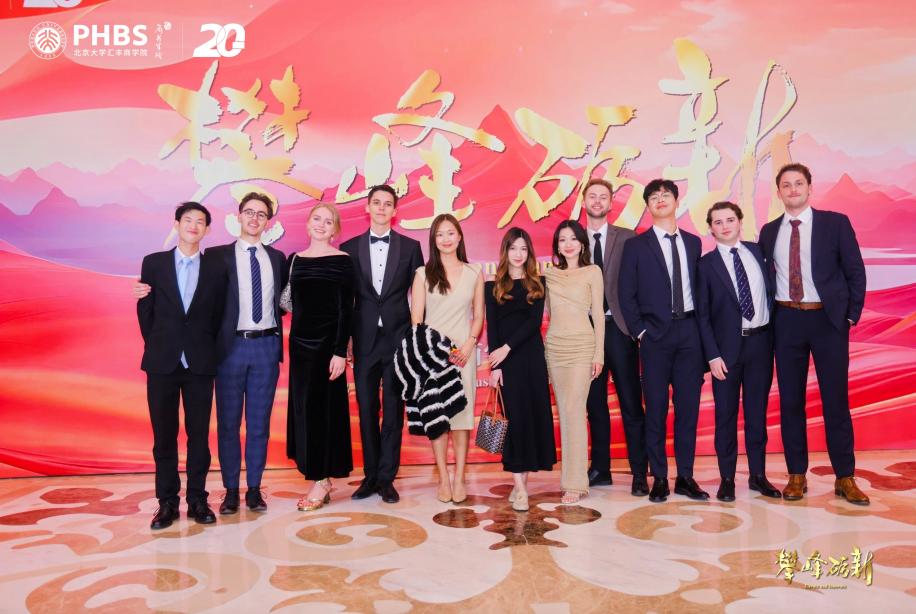
Aerin and international friends
The two later reconciled, and the project was completed smoothly. But Aerin realized that what she had done in this situation was not just "interpreting language" but "interpreting intent" — converting expressive habits from one cultural context into a form that another culture could understand. "Now, when I'm on teams with both Chinese and international students, I often help both sides understand each other's real intentions — not just the language, but the logic behind the culture," she says. "It's a small contribution I can make."
She attributes this ability to her life experience in Shenzhen. "You switch between different contexts every day, and gradually you develop a habit — not just looking at what someone says, but thinking about why they say it."
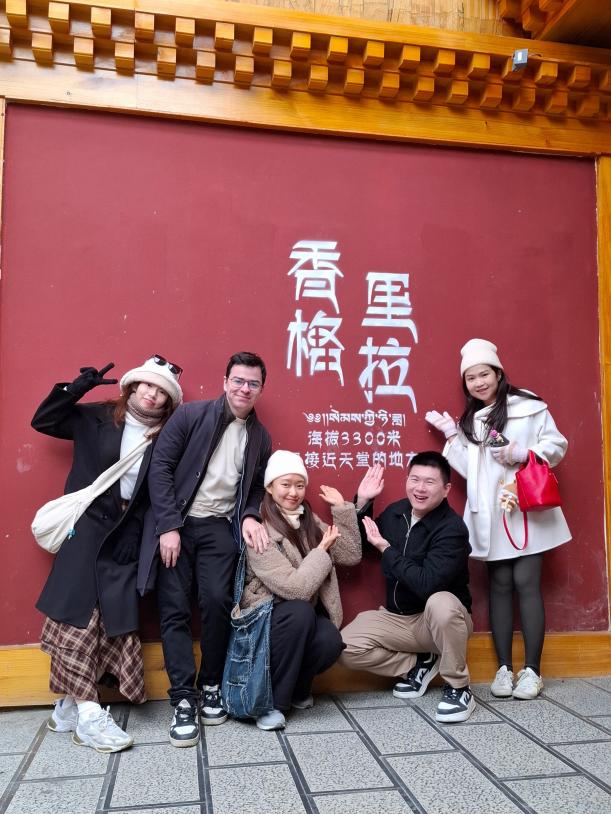
Aerin went to Shangri-La with her friends
Media Framing and APEC: A Researcher's Perspective
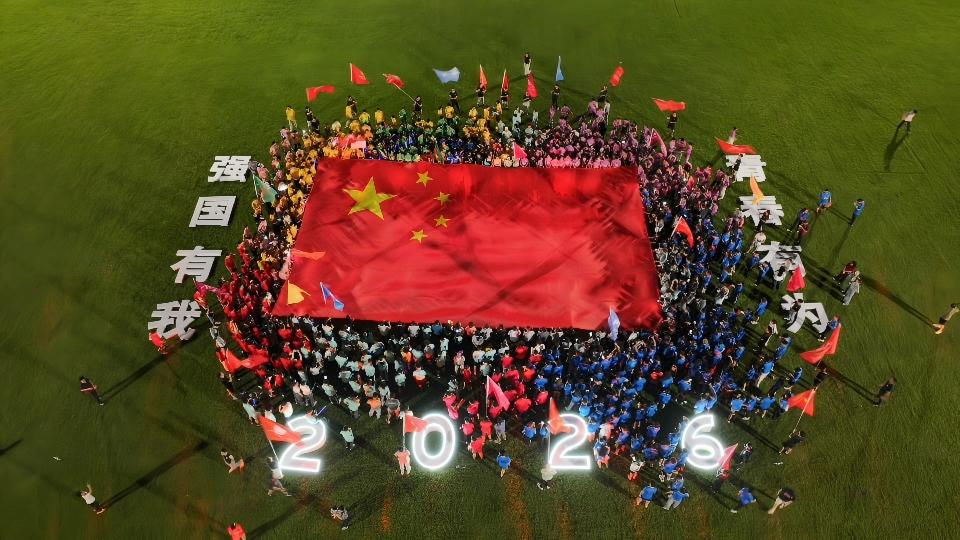
In 2025, South Korea successfully hosted the APEC summit. Aerin, who was studying in Shenzhen at the time, paid close attention. "I felt proud, but at the same time, I was thinking: Shenzhen will host it soon. What differences will there be between the two cities?"
She began to compare. Korea's APEC presented a "balance of historical depth, institutional maturity, and hospitality" — Gyeongju, the host city, with its ancient temples, Bulguksa, and a thousand years of history intertwined with diplomatic occasions. Shenzhen, the city set to host in 2026, projects "energy, innovation, and a future-oriented identity." "Busan feels more like a port city, with a diplomatic weightiness; Shenzhen feels more like a laboratory, where everything is rapidly iterating."
But Aerin doesn't think one is better than the other. What interests her more is: how are these different presentations transmitted to global audiences through media framing?
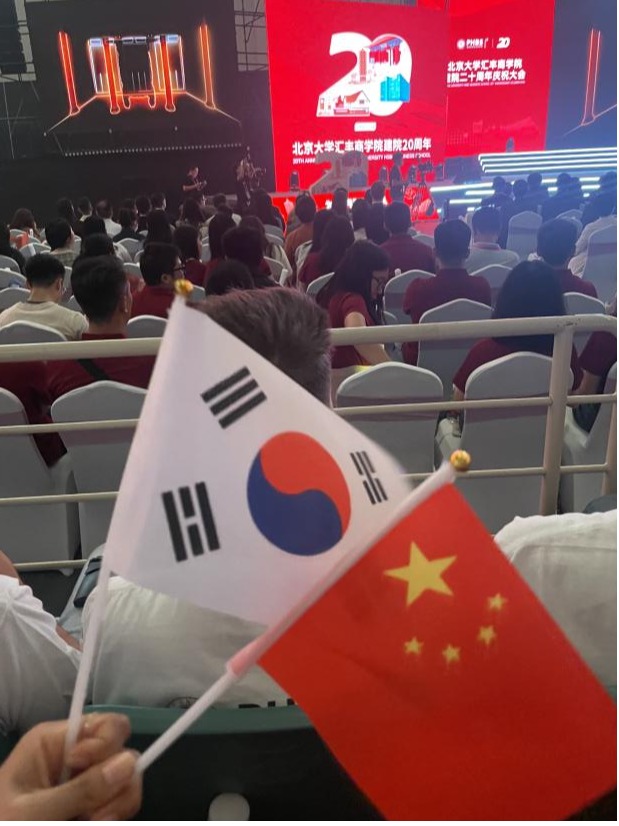
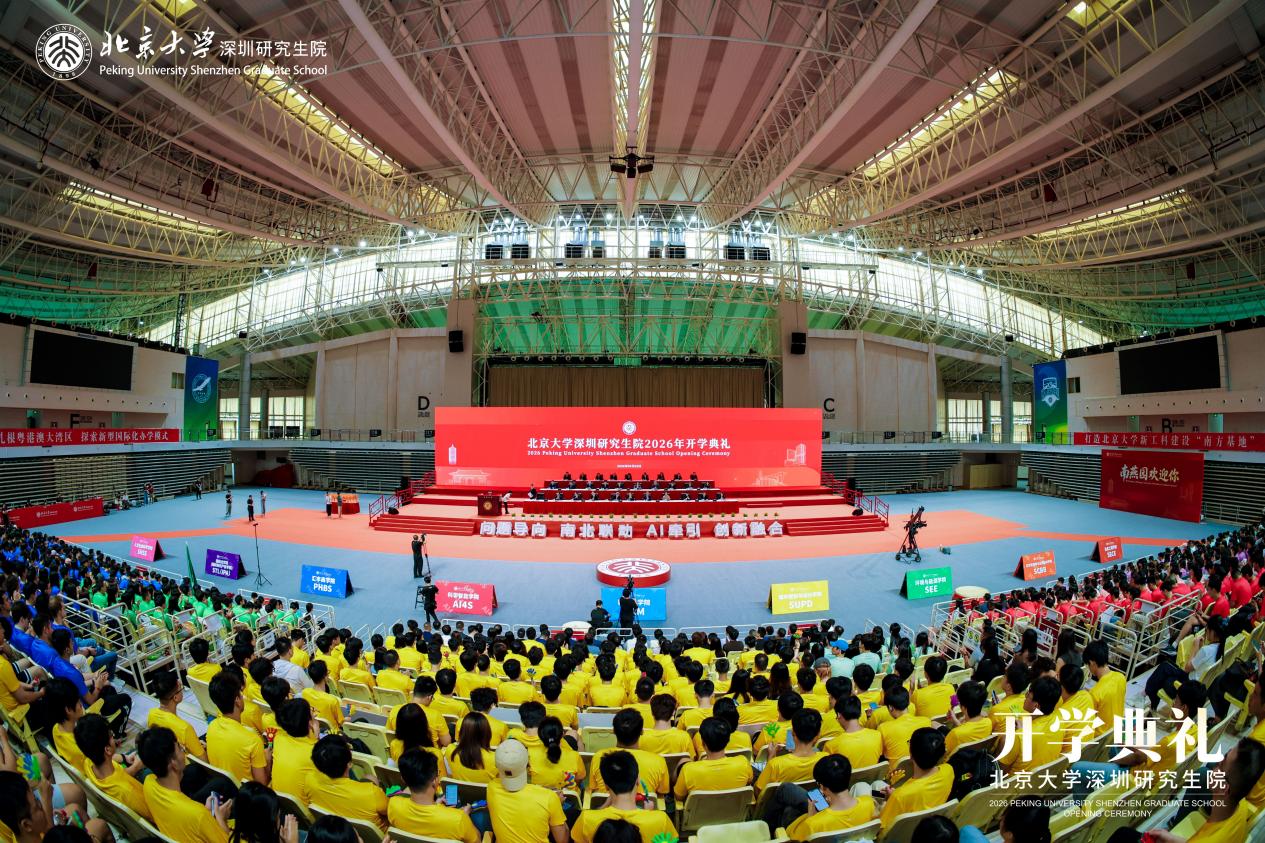
Aerin at PHBS Founding Ceremony
She gives an example: "Suppose two media outlets cover the same APEC meeting. One headline reads, 'Leaders Reach Consensus to Promote Regional Cooperation.' The other reads, 'APEC Summit Concludes, Controversial Issues Remain Unresolved.' Readers' perceptions of the same meeting would be completely different." She has studied how thumbnail titles affect viewing expectations, and now she is thinking: how will the news headlines, the camera language of the opening ceremony live broadcast, the promotional videos of the host city — how will these "frames" shape the world's perception of Asia-Pacific cooperation?
"I think the role of international youth on platforms like APEC is not to deliver grand speeches," she says. "It's to help interpret complex concepts into language that people can truly connect with. For example, 'digital transformation' — for ordinary people, it might just mean, 'I got everything done today with my phone.' If you can make that connection, that's a contribution."
She hopes that Shenzhen's APEC will be more than just a diplomatic event, but also a platform where practical cooperation in technology, youth exchange, sustainability, and regional connectivity can find concrete grounding. "I've lived here for two years. I know Shenzhen has the ability to make this happen."
Not a Sight Spot, But People
If someone asks Aerin to recommend one experience in Shenzhen, she wouldn't mention Window of the World, nor would she suggest OCT-LOFT.
"Spend some time with the people here—especially those who are creating something of their own," she says.
She recalls a chance encounter. One day, while working on her thesis at a small café in Nanshan District, a young woman in her early thirties sat at the next table, talking on the phone. Aerin overheard her discussing funding issues for a startup project—her voice carried both anxiety and unmistakable excitement. After she hung up, Aerin hesitated, then couldn't help asking, "Are you working on a startup?"
The woman looked at her, smiled, and began telling her story. She had come to Shenzhen from a small city inland, been an entrepreneur for three years, failed once, and was now on her second attempt. "The great thing about Shenzhen is that no one laughs at you if you fail," she said. "People just ask: 'What have you learned?'"
They talked for nearly an hour. Later, Aerin wrote about their conversation in her journal: "She made me understand what the 'Shenzhen spirit' really means—not written on slogans, but embedded deep in people's bones, a force that thrives with their very souls."
"What makes Shenzhen unique is not just its skyline or speed, but the mindset of the people living here. They are constantly creating, experimenting, and turning ideas into reality," she says. "The best way to understand Shenzhen is not simply to look at the city, but to listen to the people who energize it."
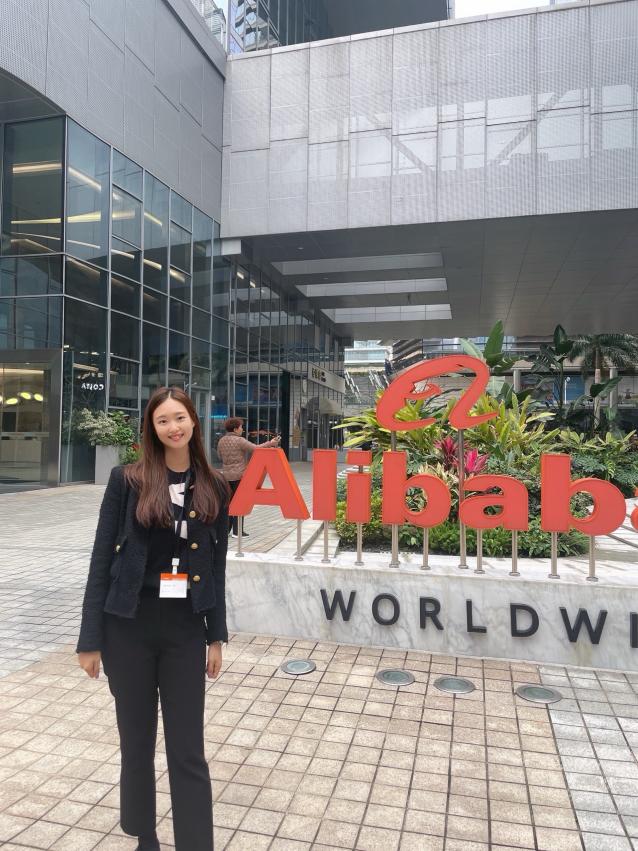
Aerin visiting Alibaba
Ten Years Later: Becoming a Broader Person
When asked about herself ten years from now, Aerin doesn't give a specific job title or position.
"I think more about the kind of person I hope to become," she says. Outside the window, sunlight filters through the leaves, casting dappled shadows on the desk. She looks at those patches of light as if gazing at a distant, but not unreachable, future.
"Ten years from now, I hope to have a broader mind, deeper judgment, and a stronger ability to connect people, ideas, and cultures in meaningful ways."
She hopes to be doing substantial and worthwhile work — work that is not only fulfilling for herself but also valuable to others. "Most importantly, I hope to keep growing into someone who lives with clarity, responsibility, and generosity, while remaining open to learning."
She pauses, as if organizing her thoughts or speaking to herself: "A meaningful future is shaped not only by achievement, but by the depth of one's character and the value one brings to the world."

Aerin running the Korean booth at the PHBS International Culture Festival
From Seoul to Shenzhen
From Seoul to Shenzhen, Aerin has spent two years finding her rhythm in a city famous for "speed" and "innovation." She studies media framing, eats suan cai yu, writes papers, and has hotpot with friends — in a quiet yet determined way, she has turned herself into a "interpreter." On one side of the interpreter are complex policy concepts and cross-cultural misunderstandings; on the other side are ordinary people's lives and genuine connections. And in between is her almost stubborn commitment to the act of "understanding."
At the end of one course paper, she wrote a sentence that her professor later circled and marked with a large "good." That sentence was:
"The meaning of communication lies not in how loudly you speak, but in whether the other person truly understands."
Perhaps that is the most essential footnote to Aerin's story. From Seoul to Shenzhen, from the classroom to daily life, from academic research to everyday interactions, all she has been doing is this one thing — helping different people understand each other.
And understanding each other is often the starting point of all cooperation.